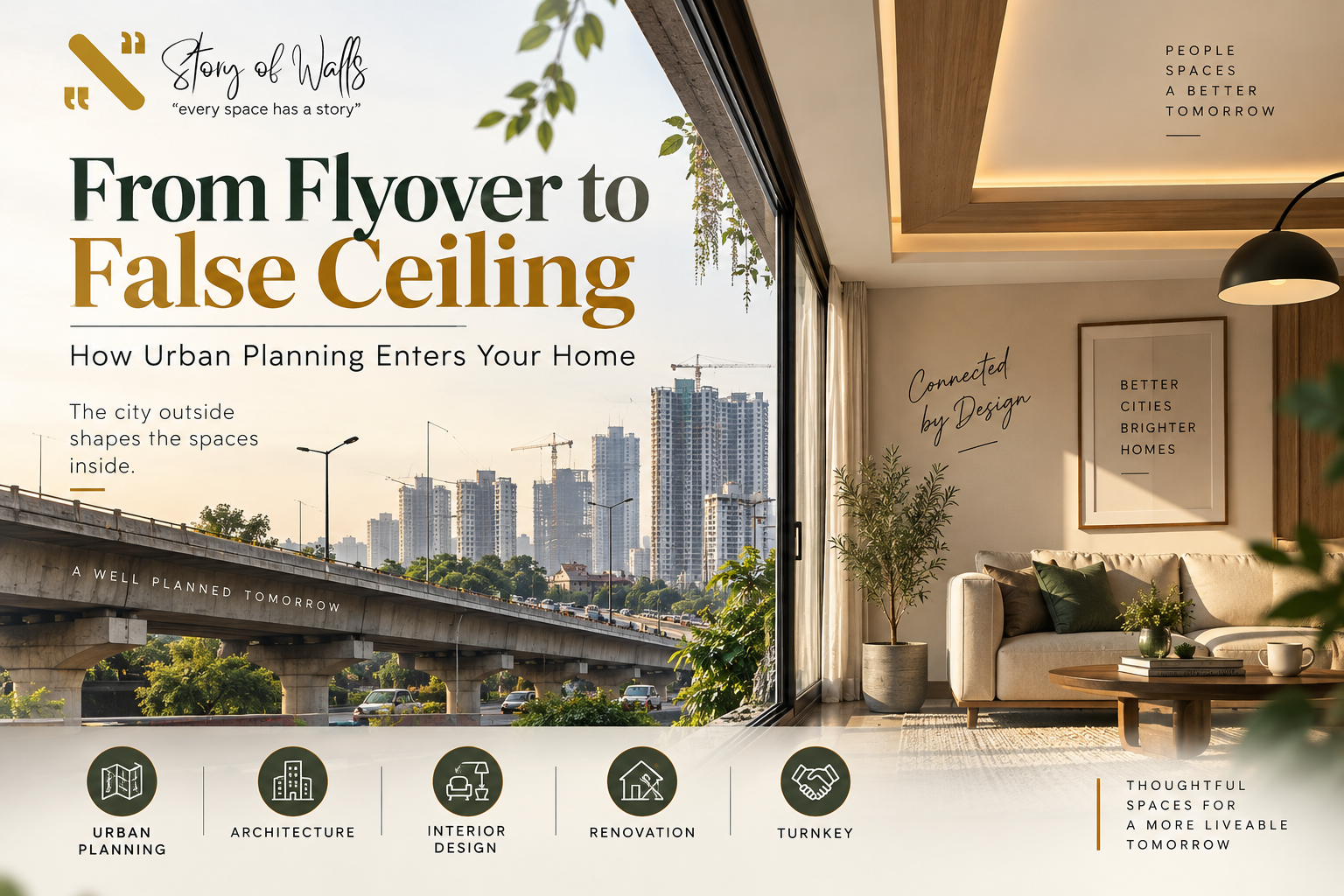
From Flyover to False Ceiling: How Urban Planning Enters Your Home
By Sonia Rana Rai
Bachelor of Urban Planning | Post Graduate Diploma in Environment & Sustainable Development
Founder, Story of Walls
We usually think of urban planning as something that happens outside our homes.
Roads.
Flyovers.
Buildings.
Parks.
Traffic.
Drainage.
But urban planning does not stop at your doorstep.
It can enter your home.
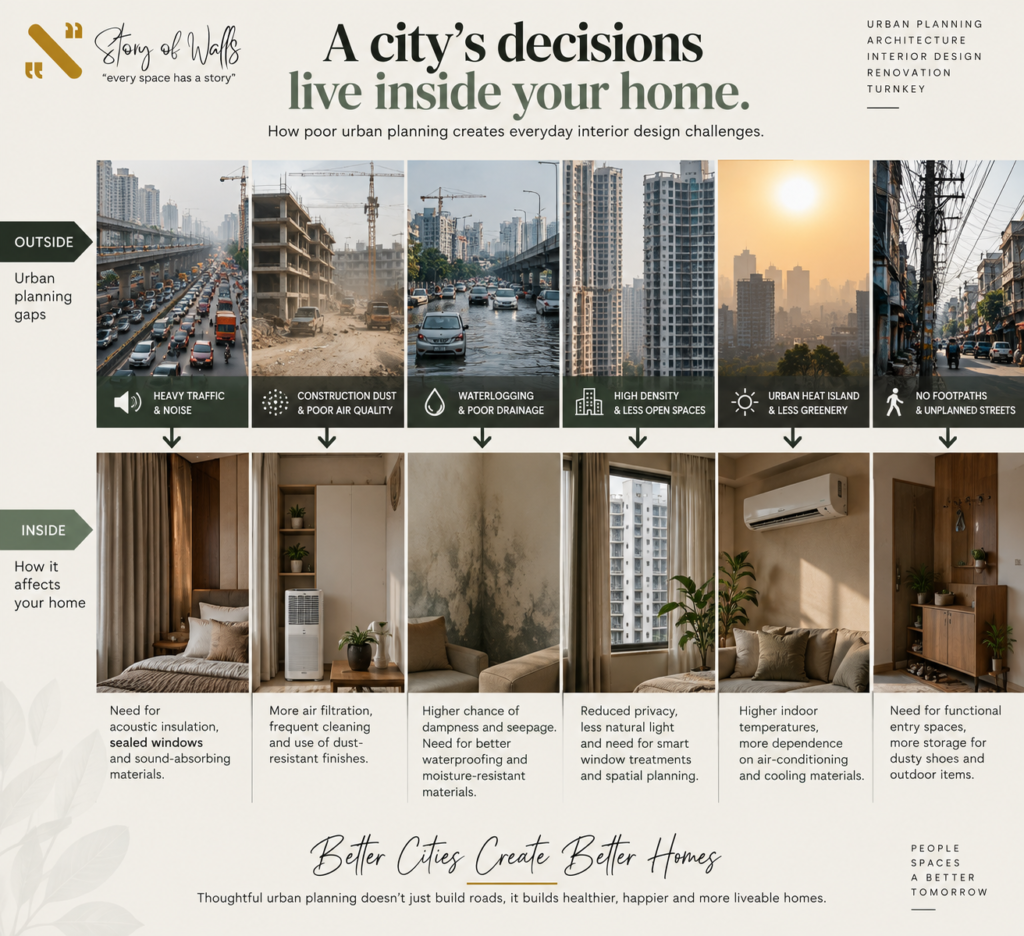
The road outside your window can affect your sleep.
The lack of trees can make your home hotter.
Poor drainage can become damp walls.
A crowded neighbourhood can reduce your privacy.
And suddenly, an urban planning problem becomes an interior design problem.
1. A busy road becomes a noise problem
Imagine your home is next to a busy road.
The traffic increases.
The horns increase.
The noise enters your bedroom and living room.
Now the interior designer has to think about:
Acoustic glass.
Thicker curtains.
Sound-absorbing materials.
Better window design.
A problem that started on the road has now reached your sofa.
2. More traffic and construction means more dust
Growing cities often mean more construction.
More roads.
More buildings.
More vehicles.
And more dust.
This affects the way we design homes.
Entry areas need better storage for shoes and outdoor items.
Easy-to-clean surfaces become more important.
Air filtration becomes more useful.
Even the choice of fabrics and finishes can change.
Good interior design sometimes means designing for the problems outside.
3. Poor drainage can become a wall problem
Waterlogging is not only an inconvenience on the street.
When water and moisture are not managed properly, buildings can face:
Dampness.
Seepage.
Mould.
Paint damage.
Bad indoor air quality.
Now the interior designer and contractor have another challenge.
Waterproofing.
Moisture-resistant materials.
Better ventilation.
Proper detailing.
Again, the problem started outside.
4. Less greenery means more heat
Look around a rapidly developing neighbourhood.
More buildings.
More concrete.
More paved surfaces.
Fewer mature trees.
The result can be a hotter environment around buildings.
And that heat eventually enters our homes.
We respond with:
More air-conditioning.
More cooling.
More electricity consumption.
Sometimes, a tree outside the window can be more valuable than another decorative element inside the room.
5. More buildings can mean less privacy
High-density development brings another challenge.
Your neighbour’s window may be only a few metres away.
A building opposite may look directly into your bedroom.
Balconies may face each other.
So interior design has to compensate.
Curtains.
Blinds.
Privacy films.
Screens.
Smart furniture placement.
The closer the buildings become, the more carefully we have to design the inside.
What happened to natural light and fresh air?
Good homes need daylight and ventilation.
But when buildings are packed closely together, windows may receive less sunlight.
Cross ventilation can also become difficult.
The interior designer then has to work harder with:
Lighting design.
Ventilation.
Colours.
Mirrors.
Space planning.
Instead of using design only to make a home beautiful, we start using it to correct what the surrounding environment has taken away.
The biggest lesson
Interior design cannot solve every urban planning problem.
A beautiful false ceiling cannot solve traffic congestion.
A designer sofa cannot fix waterlogging.
Premium curtains cannot replace missing trees.
And artificial lighting cannot truly replace good daylight.
Design can respond to a problem.
Good planning can prevent the problem.
That is why urban planning, architecture and interior design should never work in isolation.
They are connected layers of the same environment.
City → Building → Home → Human
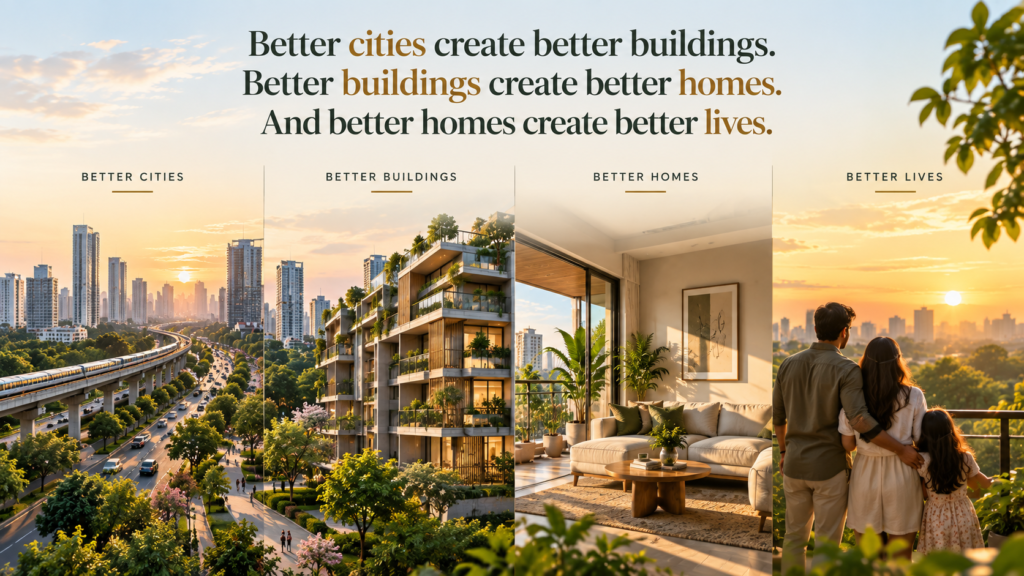
What happens outside eventually affects what happens inside.
A flyover can change traffic patterns.
Traffic can change noise levels.
Noise can change your windows.
Windows can change your interior design.
A missing green space can increase heat.
Heat can increase air-conditioning.
Poor drainage can create dampness.
High-density development can create privacy problems.
One urban decision can travel all the way to your false ceiling.
And perhaps that is the real purpose of design:
Not simply to make spaces look beautiful,
but to make everyday life healthier, easier and more comfortable.
Story of Walls
Urban Planning | Architecture | Interior Design | Renovation | Turnkey
Every space has a story.